



For decades, the biggest barrier to learning new technology wasn't the code; it was the shame of asking basic questions. AI has quietly dismantled that barrier, removing the gatekeepers and rewriting who gets to lead the next wave of innovation.
The Great Reversal: When Learning Barriers Disappear
Over nearly two decades in tech, I've navigated rooms where expertise was guarded like a secret weapon. The traditional challenges of technical learning, like finding the right resources, asking questions without judgment, and getting explanations at the right level, created invisible walls that determined who could advance.
I still remember the first time I used an AI assistant to understand a complex ML concept I'd been struggling with. No judgment, no time pressure, no feeling like I should already know this. Just patient, thorough explanations at exactly the level I needed. For the first time in my career, I felt complete ownership of my learning journey.
When was your last 'I should know this' moment? We all experience those instances where we're expected to have the answers. AI, however, turns these moments from intimidating to enlightening, offering a space where learning is embraced.
This isn't just personal comfort with new tech. It's about something bigger happening across our industry—what I call The Great Reversal.
What we're witnessing is a fundamental shift from knowledge gatekeeping to knowledge sharing. For too long, tech expertise has been concentrated in the hands of those who had the right access, connections, or credentials. AI is changing that completely. The traditional gatekeepers—the judgment, the time constraints, the assumptions about what you should already know—are disappearing.
But here's where it gets interesting: as knowledge becomes abundant, a new question emerges: What do people do with that power?
That's where two distinct paths are emerging. And this is creating what I call The Creator Divide.
The Innovation Gap: Two Paths Emerge
The Creator Divide is the most crucial phenomenon happening in tech right now, and it's not what you'd expect.
The Optimisation Path: Some techies become skilled at using AI to enhance existing workflows. They're brilliant at taking tools they know and making everything faster, more efficient, more scalable.
The Innovation Path: Others discover AI's potential as a creative platform for building entirely new solutions to problems that weren't even on anyone's radar.
Why This Divide Exists
This isn't just psychological risk aversion (though that's part of it). There's a deeper structural reason: The Inertia of the Installed Base.
Experts are tied to legacy systems, complex deployment pipelines, established infrastructure. Switching to API-driven, cloud-native paradigms represents massive overhead. They have investments to protect and systems to maintain.
The Clean Slate Advantage: Fresh perspectives start without baggage. They adopt the most efficient new tools first, without legacy constraints. No established reputation to protect, no complex infrastructure to migrate.
As a result, this creates a productive division of labour: experienced developers optimise what exists, while new voices create what doesn't exist yet.
The Real Opportunity: The future belongs to those who can bridge these paths — who understand systems deeply enough to optimise them and approach AI with the curiosity of a clean slate to transform them.
From Consumer to Creator: A Practical Framework
Here's how this transformation actually happens, and how you can identify where you stand in your journey:
| Stage | Focus | Key Outcome | Tools & Examples |
|---|---|---|---|
| Fearless Exploration | Confidence Building | Learning without barriers | AI assistants in existing workflows |
| Hands-On Problem Solving | Capability Building | Creation becomes accessible | No-code/low-code AI platforms |
| Sharing and Teaching | Community Building | From learning to leading | Publishing platforms, developer communities |
| Innovation Leadership | Gap Filling | Solving ignored problems | Full technology stacks, ethical AI frameworks |
Which stage describes you today? Self-diagnose to commit to your next step.
Stage 1: Fearless Exploration — Start with AI in your everyday tools. Instead of Googling complex concepts, query AI directly. The breakthrough: you can ask follow-up questions without anyone rolling their eyes.
Stage 2: Hands-On Problem Solving — Tackle something real. Use accessible tools to build your first model, such as an automated workflow for a recurring task.
Stage 3: Sharing and Teaching — Share what you've built. Write about projects, present at meetups, teach colleagues. Teaching amplifies learning and builds networks.
Stage 4: Innovation Leadership — Focus on challenges that insiders miss because they're too invested in existing approaches. Build transformative solutions using your clean slate as a superpower.
Why Diverse Voices Fill Critical Gaps
Companies with diverse management teams report 19% higher revenues from innovation and are 70% more likely to capture new markets (BCG, 2018). Meanwhile, studies show 44% of AI systems exhibit gender bias, often because homogeneous teams miss subtle flaws (UNESCO, 2023).
When people from varied backgrounds become AI creators, we bring:
- Fresh Eyes: Problems that experts have become blind to
- Real-World Context: Daily friction that AI could solve
- Inclusive Instincts: Natural consideration of accessibility and diverse use cases
- Clean Slate Advantage: No legacy assumptions about "how things should work"
This isn't about replacing expertise—it's about filling voids that expertise alone can't see. As you reflect on these points, consider asking yourself: 'Which everyday friction do you experience that insiders overlook?' Encouraging underrepresented voices to identify such niches can spark innovation and catalyse the generation of new ideas.
Your Strategic Advantage
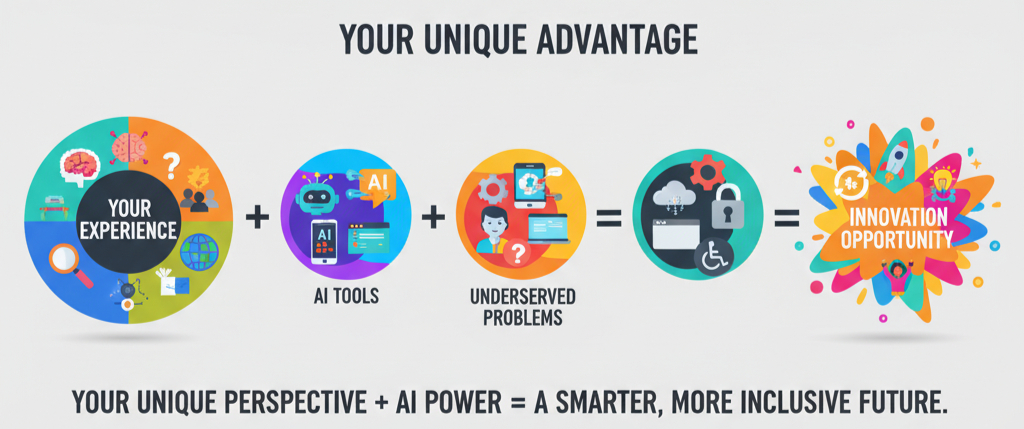
The Creator Divide represents a unique moment: tools are at peak accessibility, traditional gatekeepers matter less, and creation skills have become the new competitive edge.
For my fellow career transitioners: Your enterprise experience isn't baggage—it's perspective. You understand real business problems that pure technologists might miss.
For multilingual professionals: You spot language and cultural divides others overlook. AI amplifies this advantage by providing patient, personalised learning.
For underrepresented groups: You've navigated barriers, making you naturally better at spotting bias and building inclusive systems.
Start Building Today
This week: Experiment with an AI tool on a genuine problem you face.
This month: Build and share a small solution.
This year: Mentor others and lead discussions on inclusive AI.
Every diverse voice who becomes an AI creator doesn't just learn new skills — they solve problems others couldn't see, teach approaches others hadn't considered, and build solutions that work for people who had been overlooked.
The Creator Divide isn't a problem to solve — it's an opportunity to fill.
AI won't just rewrite code — it will rewrite who gets to create. Whether you're an industry veteran or a first-time builder, the next breakthrough might start with your question.
Resources for Your Journey
Getting Started:
- AI assistants integrated in your existing tools
- Online learning platforms like Google SKills and developer communities
- Local tech meetups like Google Developer Groups (GDGs) and diversity-focused groups like Women Techmakers
Building Skills:
- No-code/low-code platforms for rapid prototyping like:
- Appsheet: Google’s no-code app platform
- Techable Machine: Training simple AI models
- Bubble: Web application builder
- Zapier: Automation workflows
- Glide: Mobile apps from spreadsheets, and more.
- Open source projects seeking diverse contributors
- Structured ecosystems like Google's AI tools (Gemini and AI Studio for exploration, Vertex AI for building), alongside alternatives
After going through these options, consider asking yourself: Which single resource will you commit to exploring this week? By focusing on small, manageable commitments, you can more effectively turn this list into actionable plans. Once you've chosen, I encourage you to share your commitment either in the comments or with a peer. Sharing not only builds motivation but also fosters a sense of community as you embark on this transformative journey.
Amplifying Impact:
- Publishing platforms (Medium, LinkedIn, personal blogs)
- Speaking opportunities at conferences and meetups
- Mentorship programs in your communities
What’s one way you’ve seen AI lower barriers to entry in your field?
References
- BCG. (2018). How Diverse Leadership Teams Boost Innovation. Boston Consulting Group.
- UNESCO. (2023). AI and Gender Equality: Key Findings on Gender Bias in AI Systems. UNESCO Publishing.
- Bijker, W. E. (1995). Of Bicycles, Bakelites, and Bulbs: Toward a Theory of Sociotechnical Change. MIT Press.
Also published on Medium - Join the discussion in the comments!